
Paper Wasps vs Yellow Jackets: What’s the Difference?
If you’ve ever spotted a wasp flying around your porch, you’ve probably wondered—what kind is that, and should I be worried? Around Jacksonville and the First Coast, two of the most common culprits we see are paper wasps and yellow jackets. They may look similar at first glance, but they behave very differently.
Knowing which one you’re dealing with can help you understand the risk—and why it’s usually best to call in a professional.
Quick Answer: Paper Wasps vs Yellow Jackets
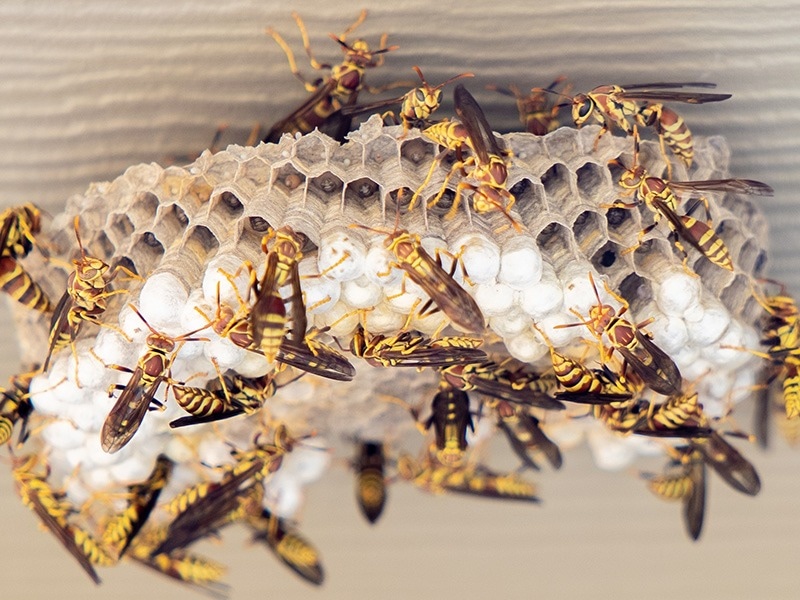
- Paper wasps are long-legged, slower flyers with open, umbrella-shaped nests.
- Yellow jackets are compact, fast, and aggressive with hidden nests—often underground.
Both can sting. But yellow jackets are far more likely to cause problems.
What Do Paper Wasps Look Like?
Paper wasps are the ones most homeowners notice hanging under eaves, soffits, and porch ceilings. They have long, slender bodies, and you’ll often see their legs dangling as they fly. Their coloring is usually reddish-brown or dark with some yellow markings, which can sometimes cause confusion with other stinging insects.
Their nests are one of the easiest ways to identify them. Paper wasps build small, gray nests that look like an upside-down umbrella. The cells are open and visible, which gives the nest that “honeycomb” appearance without any outer covering.
Where Do Paper Wasps Nest?
Paper wasps prefer spots that are protected but still out in the open. Around homes in Jacksonville and the First Coast, that usually means areas like roof eaves, porch ceilings, door frames, garage openings, and even outdoor light fixtures.
They like places that are sheltered from rain and direct sun, but still easy to access. Because of that, their nests are often right where homeowners walk every day, which increases the chances of accidental run-ins.
Are Paper Wasps Aggressive?
Usually, no.
Paper wasps are more laid-back compared to other stinging insects. They’re not out searching for people to sting, and in many cases, they’ll ignore you if you keep your distance.
But they will defend their nest if they feel threatened. That’s where problems start. A nest over your front door or near your garage can easily lead to accidental disturbances, and that’s when stings happen.
So while they’re less aggressive than yellow jackets, they’re still not something you want living right next to your home.
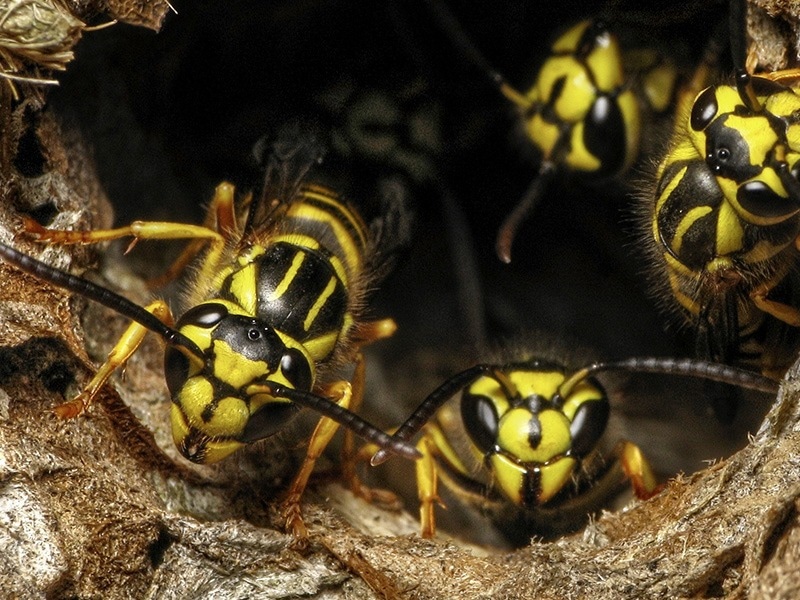
What Do Yellow Jackets Look Like?
Yellow jackets are the ones people tend to remember—for all the wrong reasons. They have bright yellow and black coloring with shorter, thicker bodies that make them look more compact than paper wasps. Their movement is quick and erratic, which adds to that aggressive feel when they’re flying around.
Unlike paper wasps, yellow jackets don’t have legs that hang down during flight. Everything about their appearance and movement makes them seem faster, tighter, and more defensive.
Where Do Yellow Jackets Nest?
This is where things get tricky.
Unlike paper wasps, yellow jackets don’t typically build open, visible nests. Instead, they often choose hidden locations. Around Northeast Florida homes, that commonly means underground nests, wall voids, or areas with dense landscaping and debris.
Some yellow jacket species can also build aerial nests attached to structures or trees. These nests are enclosed and papery, unlike the open nests of paper wasps.
Because many yellow jacket nests are hidden, homeowners often don’t realize there’s a problem until they get too close. Stepping near an underground nest or disturbing one inside a wall can trigger a fast, aggressive response.
Why Yellow Jackets Are More Dangerous
Yellow jackets are highly defensive and quick to react. Unlike many other stinging insects, they don’t hesitate to go on the offensive if they feel threatened.
They’re capable of stinging multiple times, and when they do, they release pheromones that signal other yellow jackets to join in. That’s how a single encounter can quickly turn into a swarm. On top of that, they’re strongly attracted to food and sugary drinks, especially in late summer, which puts them right in the middle of backyard gatherings.
This is why cookouts, tailgates, and outdoor meals can suddenly become a problem. If you’ve ever had a group of stinging insects come after you all at once, there’s a good chance it was yellow jackets—not paper wasps.
Paper Wasps vs Yellow Jackets: Key Differences in Nests
One of the biggest differences between paper wasps and yellow jackets comes down to their nests—and this is often the easiest way to tell which one you’re dealing with.
Paper wasp nests are open and easy to see. They’re typically attached to surfaces like eaves, railings, or porch ceilings, and you can clearly see the individual cells. Because the nest is exposed and colonies are smaller, problems are usually more noticeable early on and easier to identify.
Yellow jacket nests are the opposite. They’re hidden and enclosed, often underground or tucked inside walls and other structures. That means you may not even realize they’re there until the colony has grown larger and more defensive. By the time you notice activity, you’re often already too close for comfort.
If you can’t find the nest but you’re seeing steady wasp activity, that’s usually a red flag. Hidden nests tend to mean yellow jackets—and a higher chance of aggressive behavior.
Why DIY Doesn’t Work (And Can Make It Worse)
It’s tempting to grab a can of spray and handle a wasp problem yourself. But with stinging insects—especially yellow jackets—that approach often backfires.
In many cases, the nest isn’t fully eliminated. Hidden nests are easy to miss, and disturbing them can trigger a fast, aggressive response. What starts as a quick fix can turn into a much bigger problem.
We’ve helped plenty of Jacksonville homeowners who tried to handle it on their own first. By the time they call us, the activity is usually worse, and the risk is higher.
What Jacksonville Homeowners Should Do Instead
If you’re seeing consistent wasp activity, the safest move is to have it professionally inspected.
At Lindsey Pest Services, we’ve been protecting homes across Jacksonville and the First Coast since 1957. Our licensed technicians know where paper wasps and yellow jackets hide, how they behave, and how to deal with them safely.
We start with a detailed inspection to find active nests, identify what’s attracting them, and determine the best way to remove the problem. From there, we treat the area and create a protective barrier to help keep them from coming back.
Many homeowners choose our Best pest control plan, which includes wasp removal and stinging insect control, as well as year-round pest treatments for house-infesting pests, starting at around $60 per month.
Why Wasps Require Ongoing Pest Control in Northeast Florida
In Northeast Florida, paper wasps and yellow jackets are rarely a one-time problem. Our long warm season gives both types more time to stay active, rebuild nests, and return to the same areas around your home.
Paper wasps often come back to familiar spots like eaves, porches, and outdoor structures. Yellow jackets can be even more frustrating because their nests are usually hidden underground or inside walls, which means activity can build without being noticed.
That’s why many homeowners choose ongoing pest control instead of reacting to each new nest. With regular service, stinging insect activity can be identified early and handled safely before it turns into a larger, more aggressive problem around your home.
FAQs About Paper Wasps and Yellow Jackets
Why are yellow jackets so aggressive compared to other wasps?
Yellow jackets are more aggressive because they defend their colonies more intensely and can sting multiple times. They also release a chemical signal when they sting that attracts other yellow jackets, which can quickly escalate a situation.
What should I do if I accidentally disturb a yellow jacket nest?
Leave the area immediately and avoid swatting at them, which can make the situation worse. Yellow jackets react quickly to movement and vibration, so putting distance between you and the nest is the safest response.
Why do wasps keep flying around the same spot near my house?
This usually means there is a nearby nest or a food source attracting them. Repeated activity in the same location is often one of the first signs of a developing problem.
Can yellow jackets get inside my home?
Yes. Yellow jackets can enter through small gaps around siding, vents, or rooflines, especially if they build nests inside wall voids. Once inside, they may show up near windows or light fixtures.
Are wasp stings dangerous for everyone?
For most people, stings are painful but temporary. However, for those with allergies, a sting can cause a serious reaction that requires immediate medical attention. Multiple stings can also increase risk, even for those without known allergies.
Local Experience You Can Trust
Lindsey Pest Services is a local, woman-owned company that’s been serving this area since 1957. We’ve protected over 10,000 homes and built a reputation across the First Coast and Northeast Florida with a 4.9-star rating and more than 1,000 reviews.
When it comes to wasps and yellow jackets, local experience makes a difference.
Seeing Wasps Around Your Home?
If you’re seeing wasp activity, don’t wait for it to turn into a larger nest problem.
Call (904) 350-9406 or request your free estimate today.