
Why Summer Storms Make Fire Ant Problems Worse Across Northeast Florida
Jun 2, 2026
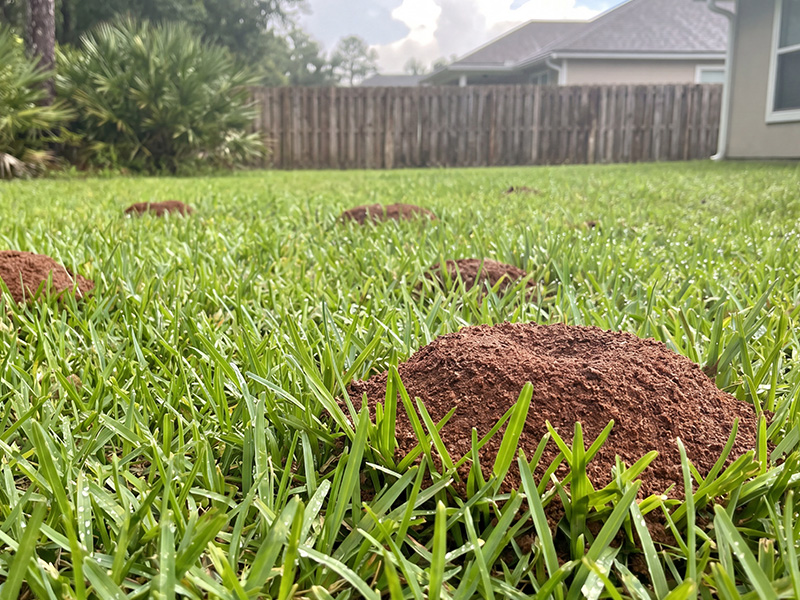
You walk outside after a big afternoon downpour, and your yard is covered in fresh fire ant mounds. They weren't there yesterday. Now there are six, maybe eight, dotting the lawn and creeping along the edge of the driveway.
It happens to homeowners across Northeast Florida every summer. Whether you're in Jacksonville, St. Augustine, Palm Coast, or elsewhere in the region, summer storms often seem to bring a fresh wave of fire ant activity.
At Lindsey Pest Services, we hear about it often — people who thought their fire ant problem was under control suddenly dealing with mounds everywhere after a storm rolls through.
The reality is that rain doesn't wash fire ants away. It actually helps make fire ant activity more visible.
What Happens to Fire Ant Colonies During a Storm?
Most of a fire ant colony is hidden below the surface. When heavy rain saturates the soil, those underground tunnels and chambers can flood. But fire ants are remarkably resilient. When water starts filling the nest, the ants go into survival mode. They move young ants and queens to safer areas, and during severe flooding, they can even form floating rafts to survive.
When floodwaters recede, fire ants waste little time rebuilding. Workers repair damaged tunnels, clear out flooded chambers, and move soil back to the surface. Some colonies re-establish themselves in the same area, while others shift to nearby higher ground. That's why homeowners often notice fresh mounds appearing across the yard after a major storm.
Our technicians see this pattern every summer throughout Northeast Florida, from Jacksonville and St. Augustine to Palm Coast and Flagler County. A yard that seemed relatively quiet before a storm can suddenly have multiple active mounds visible just days later.
If you're already noticing new mounds after recent rain, it's worth getting a professional assessment before the colonies become more established. Contact us for a free estimate.
Why Northeast Florida's Summer Weather Makes It Worse
If you've spent a summer in Northeast Florida, you know the routine: humid mornings, building clouds, and afternoon thunderstorms. Fire ants happen to do very well in those conditions.
Northeast Florida's sandy soil plays a big part. That's especially true in coastal communities where fast-draining soils create ideal conditions for fire ants to rebuild after heavy rain. The ground warms back up quickly, giving fire ants exactly what they need: loose, warm soil that's easy to tunnel through and build mounds in. Neighborhoods with irrigated landscaping and thick mulch beds are especially attractive because the combination of moisture and organic material creates ideal conditions for colonies to thrive.
In many communities across Northeast Florida, retention ponds and stormwater systems are common landscape features. After a heavy storm, some fire ant colonies shift toward higher ground while others rebuild in place — which means homeowners may notice fresh mounds in front yards, around pools, along driveways, and near play areas. Workers quickly move soil to the surface as they repair tunnels and rebuild nests, making mounds seem to appear almost overnight.
The cycle of rain and heat continues for much of the summer, and fire ants take advantage of it. Colonies remain active, expand their nests, and continue building mounds throughout the season.
Can You Get Rid of Fire Ants by Treating Individual Mounds?
When mounds start showing up, a lot of homeowners grab a bag of granular mound treatment and start spot-treating. It makes sense — the mound is right there, and you want it gone. But it rarely solves the problem for long.
The challenge is that visible mounds are often only part of the issue. A property may support multiple fire ant colonies at the same time, and treating a single mound doesn't address activity elsewhere in the yard. During periods of frequent rain and colony movement, homeowners often eliminate one mound only to find new activity nearby days later.
What makes fire ants especially tough in Northeast Florida is that colonies can become established across large portions of a property. Treating individual mounds is often a temporary fix that fails to address the broader infestation.
That's why professional fire ant control focuses on treating the entire perimeter and surrounding yard, not just the visible mounds. If you're stuck in the cycle of knocking out one mound only to find new ones a week later, give us a call — there's a better approach.
How Lindsey's Best Plan Protects Your Entire Yard
If fire ants are a recurring problem on your property, Lindsey's Best Plan provides ongoing protection as part of a comprehensive home pest control program.
The Best Plan includes quarterly pest service, protection against more than 30 common household pests, rodent control and trapping, seasonal mosquito suppression, wasp removal, and fire ant control extending up to 20 feet from your foundation. That expanded treatment zone helps protect the areas where fire ants are most likely to establish colonies.
With quarterly service visits, your technician can monitor changing conditions around the property and address pest activity before it becomes a larger problem. During Northeast Florida's long storm season, that ongoing protection helps homeowners stay ahead of fire ants and many of the other pests that thrive in warm, humid conditions.
Frequently Asked Questions About Fire Ants in Northeast Florida
Does heavy rain kill fire ants?
Usually not. Fire ants are highly adaptable and often survive flooding by protecting the colony and rebuilding once conditions improve.
Can fire ants get inside my home?
Yes. Fire ants can enter through gaps around doors, utility penetrations, and foundation cracks, especially after heavy rain pushes colonies closer to the structure.
Are fire ants active year-round in Northeast Florida?
Fire ants remain active throughout much of the year in Northeast Florida, although activity is typically highest during the warm, rainy months of summer.
Take Back Your Yard from Fire Ants
If fire ant mounds appear across your yard after every storm, ongoing professional treatment is the most effective way to take control. Lindsey Pest Services has been protecting homes across Northeast Florida since 1957, serving Jacksonville, St. Augustine, Palm Coast, Flagler County, and surrounding communities.
Give us a call or request a free estimate online to find the right plan for your property.